
AI Is Helping Us Break Eggs Faster. But Are We Learning Anything?

AI is not just another technology rollout. It is an organisational-design moment.
By Raatha Ganesh - Black Dog Consultants
You have to break a few eggs to make an omelette.
That’s what we say when we want permission to experiment.
Try something. Make a mess. Learn from it. Make something better next time.
Fair enough. But AI changes the kitchen.
Across Asia-Pacific, AI is helping organisations break far more eggs, far faster.
Teams are generating more analysis, proposals, content and decisions in less time than ever before.
Which sounds useful. Until you ask the awkward question:
Is AI helping us learn faster or simply helping us make mistakes at speed?
AI makes it easier to produce at speed but harder to ensure learning keeps pace. That matters because speed alone is not capability.
We have been here before
This is not the first time technology has forced organisations to rethink how work gets done. It may just be the first time technology has landed in almost everyone’s wor...
The Coach as a Phoenix

There is a moment in coaching that looks like nothing.
By: Dawn Issac - Black Dog Consultants
The client pauses.
Looks away.
Says, ‘I don’t know.’
Or says nothing at all.
That is usually when the coach feels the itch.
Ask another question. Fill the silence. Help. Rescue. Move things along.
But what if the most useful thing is to stay still?
Coaching is often described as helping others grow. Expanding thinking. Shifting behaviour. Finding a way forward when the path has gone foggy.
In my previous Ahead of the Pack article, Stop treating coaching like a perk for the elite, I explored why coaching should not be reserved for senior leaders and high-potential talent.
This time, I want to turn the spotlight around.
Who is developing the coach?
Because coaching is not only about the person sitting opposite us. It is also about the person doing the listening.
The coach brings themselves
A coach may arrive with experience, training, qualifications and well-practised questions.
...A retrospective is only useful if something changes

We had a good discussion. So why are we making the same mistakes?
By: Swathi Vallabhaneni - Black Dog Consultants
Most retrospectives start with good intentions.
We gather the team.
We ask what went well.
We ask what didn’t.
Someone writes notes. Someone nods. Someone says, ‘Good discussion.’
Then everyone goes back to work and does exactly what they did last time.
Which raises an awkward little question.
What was the point?
When I look closely, the problem often points back to one uncomfortable place: me.
Maybe I didn’t take enough ownership.
Maybe the action was too vague to repeat.
Maybe I had already moved on to the next urgent thing, dragging my lessons behind me like a forgotten suitcase.
A retrospective is not extra admin. It is how work gets smarter.
Without it, you can stay busy for years and still keep tripping over the same chair.
Reflection is not the finish line. Behaviour is.
A retrospective should not be treated like a box we tick after the work is done.
I...
How to Design Learning Experiences That Actually Work - Start With the Room

Space Matters: A not-boring guide to planning your L&D event… unless watching minds drift before coffee is the plan
By: Heice Yau and Swathi Vallabhaneni - Black Dog Consultants
Your training venue isn’t just where you plonk chairs and wheel in a flipchart.
It’s your silent co-facilitator.
The vibe-setter.
The difference between “that changed how I think” and “I mostly remember the biscuits.”
If you want your L&D session to stick, don’t sleepwalk into booking the nearest soulless hotel conference room.
Here’s what to look for instead…
Ambience isn’t an afterthought – it's the atmosphere engine
Picture this: you walk into a room that feels like a cave - dark, dreary and a bit claustrophobic.
Yikes.
Atmosphere matters.
It’s more than a ‘nice to have’ - it’s the unspoken signal that says: “we care about this.”
Choose a venue that inspires creativity and collaboration.
Look for spaces with quirky décor, textures that aren’t plastic, or a splash of something unexpected.
Peopl...
What if we've got executive presence all wrong?

By Raatha Ganesh, GM Singapore at Black Dog Consultants
TL;DR (for the time-starved):
We’ve glamourised the loudest voice, the biggest energy, the “command-the-room” aura.
How often does that charisma silence nuance?
How many great ideas go unheard because presence is mistaken for volume?
I once worked with a leader who barely spoke in meetings - but when she did, the entire room leaned in. She didn’t fill the room. She tuned into it. Her power was in what she noticed, not what she projected.
That’s when it hit me: real executive presence isn’t about performance. It’s about attunement.
It’s not a spotlight - it’s a mirror.
It’s not a solo - it’s a dance.
In today’s climate, attunement isn’t soft - it’s strategic.
What’s more powerful: being heard... or hearing what others miss?
We need to talk about presence.
Not the kind that lights up a stage or owns the mic.
Not the one that turns heads in a boardroom.
I mean the kind that notices.
That listens before it speaks.
That ...
The coaching industry is changing - but not how you think
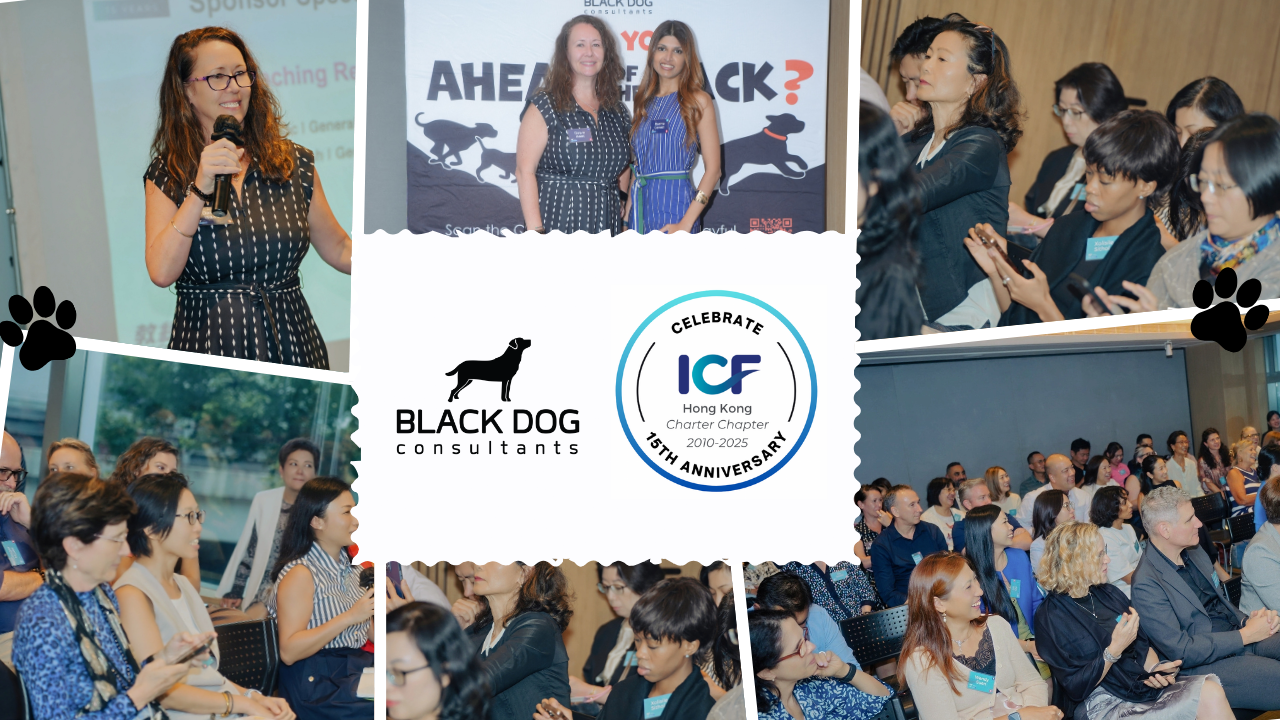
Authors: Dawn Isaac and Raatha Ganesh
Most event sponsors use the mic to sell.
We used ours to listen.
At ICF Hong Kong’s 15th anniversary, we ditched the pitch deck and asked six sharp questions instead.
Then we shut up and handed the mic to 86 coaches.
The responses weren’t polite noise.
They were a raw signal.
Some were bold. Some were hesitant.
But nearly all were hungry - for something better.
This wasn’t a survey.
It was a pulse-check.
And what we heard might just be the clearest signal yet of where coaching is headed next.
🦴 Here’s the chew toy version of what we learned:

So, what’s driving coaching demand right now?
Q1: What’ll spark the biggest increase in coaching in the next 24 months?
- Organisational transformation → 41%
- AI-enabled coaching → 33%
- Career development → 15%
(Side mentions: cost, regulation, geopolitics)
🐾 Signal:
People don’t hire a coach when the satnav’s working. They call in reinforcements when the road’s closed and Google Maps has a meltd...
Leadership Is a Circus. So Be the Ringmaster.
By Dawn Isaac, COO at Black Dog Consultants
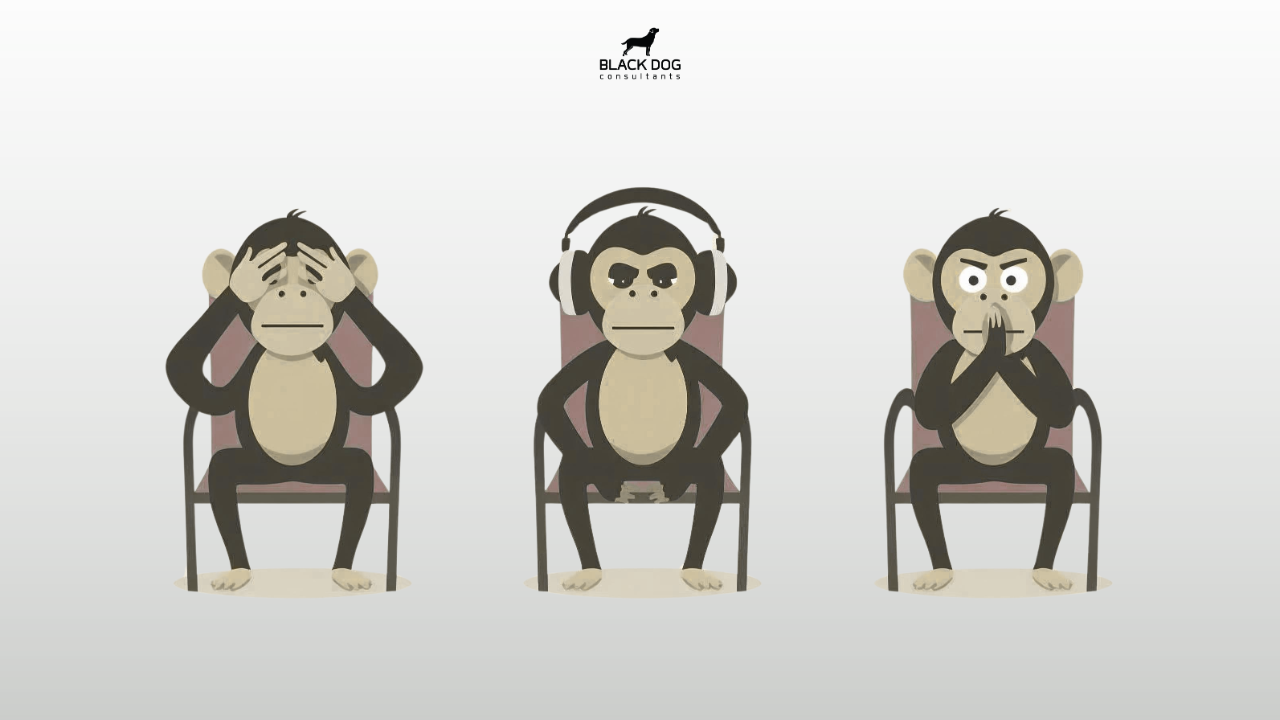
“Not my circus, not my monkeys.”
I first heard this phrase a few years into being a people manager.
I remember chuckling, smugly relieved that whatever chaos was unfolding - wasn’t mine.
Not my monkeys. Not my mess. I could just sip my coffee and watch the show.
But I was quite proud of my own circus. As an aspiring Greatest Showman, I thought I ring mastered with flair.
My acrobats were slick, the clowns were funny (on purpose) and the whole thing ran on time.
“My circus, my monkeys, 10/10. Move along. Nothing to see here.”
The reason this popped into my head again? A family member sent me a meme about the “fourth monkey” - apparently, modern life has bred a new one. But instead of adding to the troop, it got me thinking about the original three. And then about work.
What are our monkeys?
How many of them are invisible?
And do we even know we’re feeding them?
Monkey One: Seeing Effort (Before It Disappears)
Deadlines met. Tasks ticke...
Black Dog Consultants Platinum Sponsor at ICF Hong Kong 15th Anniversary Flagship Event
🎥 We didn’t just talk about transformation - we felt it.
You can’t fake real connection.
And at this year’s ICF Hong Kong Chapter 15th Anniversary Flagship Event, it was everywhere.
We came. We spoke. We hugged strangers.
Black Dog Consultants were proud sponsors and speakers this year and we loved every minute.
✨ 18 global thought leaders
🔥 Keynotes that made us pause
⚡ Breakout labs with real a-ha moments
💬 150+ bold, curious, change-hungry humans
From the first handshake to the final hug, this was time well spent.
We didn’t just show up.
We listened. We learned.
And we left charged with possibility.
🖤 To the ones we met: thanks for the sparks.
Want to work with us? Connect at www.blackdog-consultants.com
The ROI of radical optimism - why belief belongs in your budget

Author: Raatha Ganesh, Head of Partnerships, Black Dog Consultants
Most leaders love the idea of transformation.
Until it requires belief. Until it requires budget.
Then? Silence.
McKinsey says long-term thinkers outperform on profit and revenue. Gallup links optimism in leadership to higher engagement, retention and crisis performance.
So the data’s clear. Playing the long game works.
And yet - Most organisations keep rewarding short-term wins and clinging to the status quo.
What’s the result?
Inertia. A quiet, comfortable force that buries bold ideas in the 'someday' folder.
The Pattern We See (And You’ve Lived)
- Workshops light the match. Leaders leave with post-its full of promises.
- Fast-forward 30 days: No structure. No follow-up. No pulse.
- That bold idea? Now hibernating in someone’s inbox marked “maybe later.”
- The idea wasn’t weak. The system was.
Radical Optimism Isn’t Naïve. It’s Necessary.
And no, we don’t mean the “everything will be fine” type on a dusty mo...
Stop treating coaching like a perk for the elite. It’s rocket fuel for your real change agents

By Dawn Isaac: COO at Black Dog Consultants
Coaching is traditionally reserved for the VIPs. The C-Suite. The high-flyers. The biggest earners. Get the title, grab the corner office and voilà – you’ve earned a professional development concierge to fine-tune your already robust skill set.
We think it’s time to flip the script.
What if we’ve been backing the wrong horse? What if the real coaching revolution belongs not to the top, but the middle?
The unsung heroes: middle managers
Middle managers don’t just sit between layers of org charts. They absorb pressure from above, keep teams afloat, juggle targets, people problems and the occasional crisis of meaning.
They’re the ones reaching for the duct tape when things fall apart - patching up gaps no one else wants to see. And yet? They’re often left out in the cold when it comes to their real, impactful development.
It’s not just unfair. It’s a massive, missed opportunity. These folks are the heartbeat of the business. They turn strat...
